Kubernetes IDS and IPS: What They Protect—and What They Don't

Learn where Kubernetes IDS and IPS stop working, what threats they miss, and how runtime security, RBAC, and admission control close the gaps.

Yes, you still need IDS and IPS in Kubernetes in 2026. They catch exploit attempts against exposed services, known CVE traffic, and command-and-control callouts - the network-visible half of an attack.

What they can't see is what happens after an attacker is already inside: encrypted pod-to-pod traffic, stolen service account tokens, legitimate-looking API calls. This article shows where that line falls, why it falls there, and what has to cover the other side.

If you're responsible for a Kubernetes platform, it's easy to assume that deploying IDS or IPS covers the biggest security risks. In practice, modern attacks rarely stop at the network perimeter - they start there and then move somewhere your network tooling cannot follow.

Why Kubernetes Changed the Rules for IDS and IPS

Traditional IDS and IPS were built around a stable assumption: hosts have addresses, addresses stay put, and traffic crosses a perimeter you control.

Kubernetes breaks every part of that.

Pods don't live long enough to investigate. A pod might exist for ninety seconds. By the time an analyst opens the alert, the pod is gone, its filesystem is gone, and the IP belongs to something unrelated.

Detection has to speak in workload identity - namespace, service account, deployment. Most network tooling speaks in IP addresses.

The traffic moved sideways. In a monolith, one request stayed inside one process. In a microservices cluster, the same transaction is fifteen internal calls across a flat network where any pod reaches any other by default.

That internal traffic dwarfs anything crossing the perimeter, and with a service mesh most of it is encrypted - your IDS is watching a conversation it can't hear.

Autoscaling breaks inventory. Node counts change hourly, deployments roll daily. Any tool depending on a curated list of what should be running is always out of date.

The API server has no traditional equivalent. From one authenticated endpoint you can read secrets, exec into containers, and schedule privileged workloads on any node.

To an IDS, a kubectl exec dropping an attacker into your production database looks like ordinary HTTPS to port 6443. The most powerful attack surface in the cluster is, at the packet level, nearly invisible.

None of this makes the classic tooling useless. It was designed for a different problem.
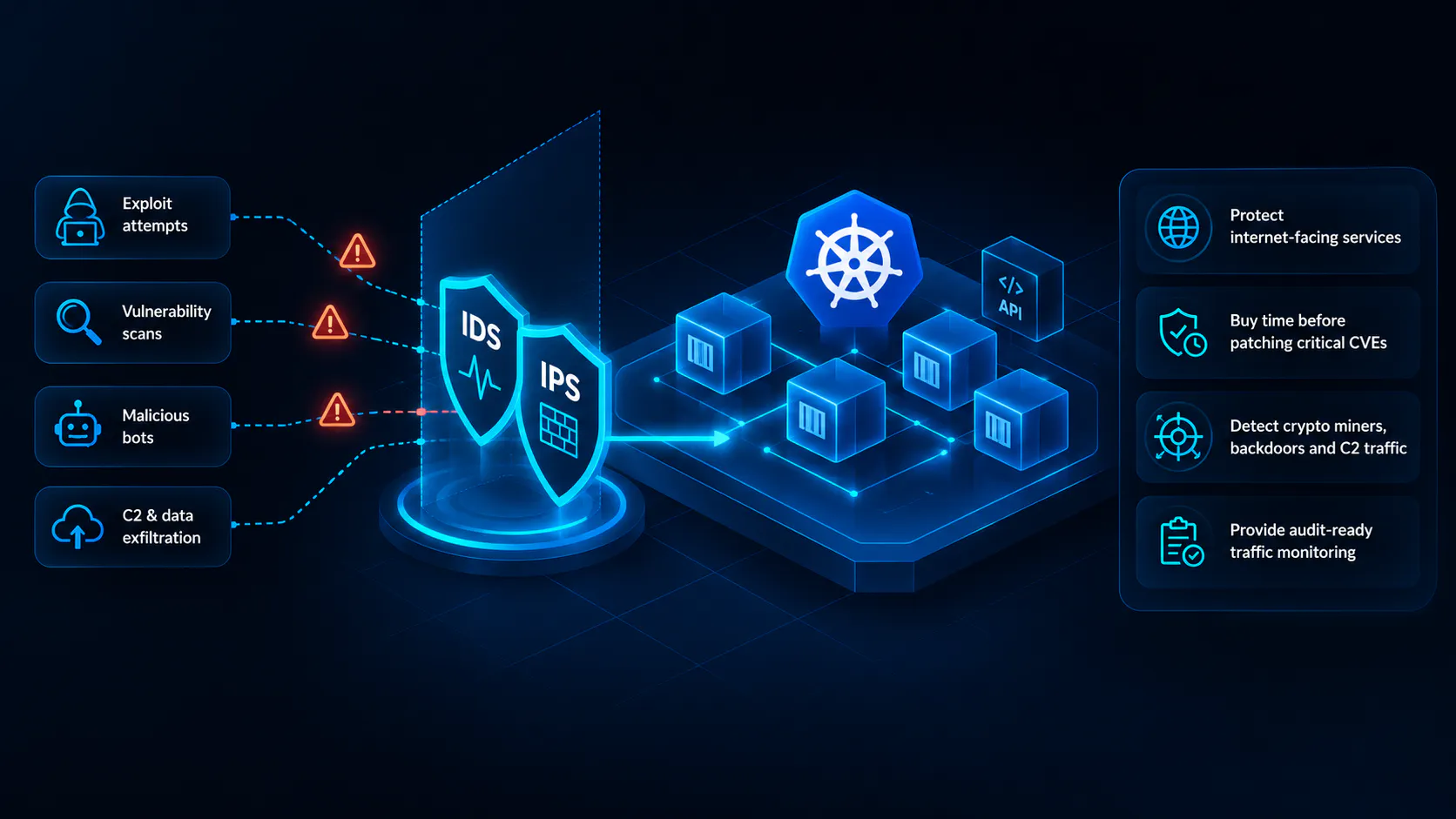
Where IDS and IPS Still Protect Your Cluster

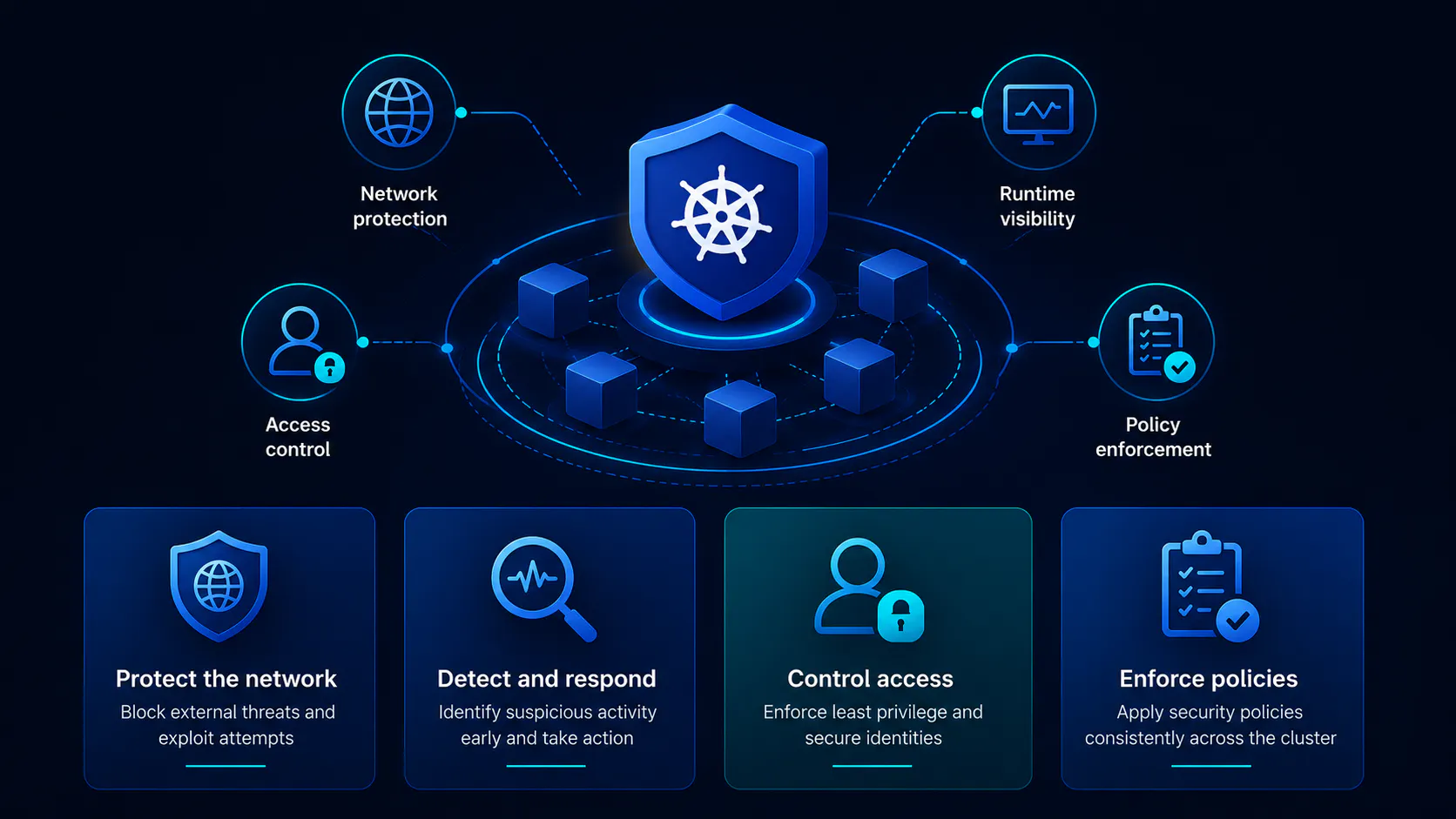
Kubernetes IDS IPS diagram

Skip them and you lose real coverage. The attacks they catch are the ones that happen most often, because they're the ones that scale.

They see the front door. Most compromises still start with an exploit against something internet-facing, and blocking at the edge stops mass-scanning before it reaches code execution.

Most attackers aren't targeting you. They're targeting every cluster running a specific vulnerable version - which is how an unremarkable service with a known CVE becomes a business incident.

They cover the gap between disclosure and patch. A critical CVE drops Tuesday, your upgrade window is three weeks out. A virtual patch at the IPS layer buys those three weeks.

That gap got wider in 2026. Kubernetes SIG Network retired Ingress NGINX in March - repository archived, no releases, no security patches - and the Steering Committee's statement put the affected footprint at roughly half of cloud native environments.

For anyone still running it, that's an internet-facing component accumulating unpatched vulnerabilities indefinitely. Network mitigation is a stopgap while you migrate, not a fix, but it's the difference between managed risk and open exposure.

They catch the loud parts of post-compromise activity. Cryptominers have to reach a mining pool. Backdoors have to reach C2. Exfiltration has to leave. Egress inspection and DNS monitoring pick all three up.

They produce compliance-grade evidence. For PCI DSS, HIPAA, or SOC 2, auditors want proof that traffic is monitored. Their absence is an audit finding whether or not you were ever breached.

Treat this as the base layer: necessary, not sufficient. The fastest way to see why is to follow one attack through.

A Real Attack Scenario: Where IDS Stops Seeing the Threat

The pattern below isn't hypothetical. It's the sequence Aqua Security's research team documented in the TeamPCP campaign that began in December 2025 against exposed Docker and Kubernetes APIs, and Palo Alto's Unit 42 has reported the same chain across unrelated intrusions.

StepWhat the attacker doesWhat the IDS sees

1. Initial access

Exploits an RCE in a public-facing service, gets a shell in the pod

Everything. Known signature match. With IPS in blocking mode, the attack ends here

2. Identity harvest

Reads the service account token mounted at /var/run/secrets/…

Nothing. A process read a file. No packets

3. Recon

Queries the API server: list pods, services, secrets

Nothing useful. Authenticated TLS to :6443, identical to your CI pipeline

4. Lateral movement

Token has pods/exec - runs commands in other pods via the API

Nothing. This is API traffic, not pod-to-pod. No east-west trace at all

5. Persistence

Deploys a privileged DaemonSet mounting the host filesystem on every node

Nothing. A legitimate, authenticated create request

6. Monetization

Miners start, or data starts leaving

An alert. Finally

Assume step 1 didn't stop it - obfuscated payload, rule a week behind, whatever. From that point the attacker never crosses an inspected boundary again.

Steps 2 through 5 happen in silence. From the network's point of view, nothing suspicious is happening. From the attacker's point of view, the cluster is already theirs.

The business consequence sits in step 2. A compromised service account isn't only a security issue - depending on what it can reach, it may expose customer data, halt production workloads, or breach a compliance obligation you've contractually committed to.

And because tokens are increasingly bound to cloud IAM roles, a stolen in-cluster credential can become access to storage and managed databases outside the cluster entirely.

Every one of those silent steps is visible somewhere else:

  • Runtime security sees a process reading the token path and spawning a shell in a container that has never run one.
  • Audit logs record the exec calls and the DaemonSet creation.
  • Admission control rejects a privileged host-mounting workload outright.
  • Tight RBAC makes the harvested token worthless at step 4.

The threat was never invisible. It was invisible to the network.

Building a Modern Kubernetes Security Strategy

Kubernetes protection diagram

Instead of relying on a single layer, modern Kubernetes platforms distribute controls across the software lifecycle. Each stage catches what the previous one couldn't.

  • Before deployment - image scanning catches vulnerable dependencies; admission control enforces what may run at all. No privileged containers, no host mounts, no unsigned images. Making an attack class impossible is cheaper than detecting it later.
  • At the network layer - IDS and IPS handle perimeter and egress; Network Policies segment the cluster so a compromised pod can't reach the other four hundred.
  • At runtime - eBPF tooling observes kernel behavior: process execution, file access, privilege changes. Community benchmarks put typical CPU cost in the low single digits per node, rising with syscall volume, so measure on your own I/O-heavy workloads first.
  • At the identity layer - RBAC decides what a stolen credential is worth; audit logs make API activity reviewable.

Each control has a defined blast radius, and attackers live in the gaps between them.

Kubernetes Security Coverage Matrix

Use this matrix to quickly identify which security layer covers each stage of an attack.

ThreatWhat actually catches itWhere IDS / IPS stand

Known CVE in a running dependency

Image scanning in CI; IPS virtual patch

Strong. Buys weeks until you can upgrade

Malicious or backdoored image

Image scanning, then runtime security

Blind. It arrives through your own pipeline

Service account token theft

Runtime security

Blind. A file read produces no packets

Lateral movement via the Kubernetes API

RBAC limits it, audit logs record it

Blind. On the wire, identical to CI

Lateral movement pod-to-pod (encrypted)

Runtime security; Network Policies

Blind. Mesh traffic can't be inspected

Container escape / host access

Runtime security; admission control

Blind. Happens below the network layer

Privileged workload deployment

Admission control

Blind. A legitimate authenticated API call

Cryptomining

Runtime security; egress inspection

Partial. Caught late, at payout

Data exfiltration to external C2

IDS/IPS egress and DNS monitoring

Primary. Traffic finally leaves the cluster

Over-permissive RBAC abuse

RBAC review; audit logs

Blind. Nothing is technically violated

CI/CD supply chain compromise

Image signing at admission; runtime security

Blind. Happens before the cluster

The pattern is simple: every control leaves blind spots. Security improves not by replacing IDS with runtime security, but by combining controls that cover different phases of an attack.

Read the right-hand column top to bottom. Network detection owns the first row and the second-to-last one. Everything between them is somebody else's job.

That last row deserves a note. On 19 March 2026, the same group from our scenario compromised Trivy - the most widely adopted open-source scanner in the cloud-native ecosystem. Per Aqua's own advisory (CVE-2026-33634), a malicious release was published and 76 of the 77 version tags in trivy-action were force-pushed to credential-stealing code.

Trivy runs in CI with access to pipeline secrets by design. Compromise it and you get cloud credentials, SSH keys, and Kubernetes tokens in one pass.

Your scanner was the attack vector. And note where the cost landed: every affected organisation had to treat its pipeline as compromised and rotate every secret it touched - days of engineering time, triggered by a tool bought to reduce risk.

Common Mistakes That Leave Kubernetes Clusters Exposed

Kubernetes security mistakes infographic

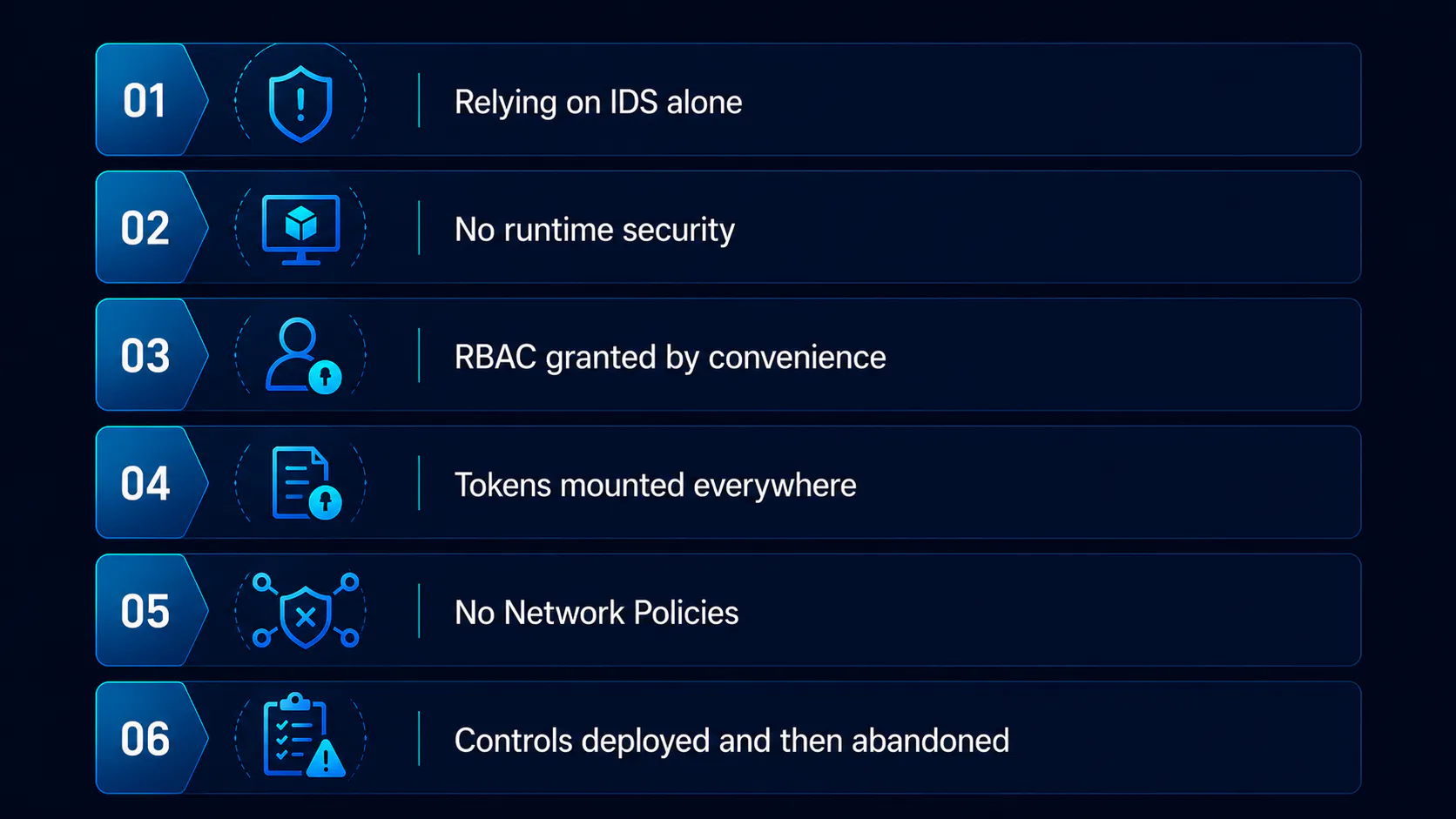
1. Relying on IDS alone. You cover the first and last step of an intrusion and nothing in between. Dwell time in that gap is what turns an incident into a breach notification.

2. No runtime security. The largest blind spot in most clusters - everything a container does after it starts goes unobserved.

3. RBAC granted by convenience. Wildcard verbs, cluster-wide roles, pods/exec left over from debugging. This turns one compromised pod into a compromised cluster.

4. Tokens mounted everywhere. Most pods never call the API, yet every one ships an attacker a credential. automountServiceAccountToken: false is a one-line fix.

5. No Network Policies. On a flat default network, an attacker who lands anywhere reaches everything.

6. Controls deployed and then abandoned. Scan results nobody enforces at admission. Audit logs nothing consumes. Policies correct at launch and drifted within a quarter. An unmaintained control is worse than none, because it shows up green on a dashboard.

How to Choose the Right Kubernetes Security Stack

There's no universal stack, and anyone selling you one is selling you their product catalogue. What changes is not the list of controls but the order you invest in them.

EnvironmentBiggest exposureWhere to spend first

Startup, single cluster

Misconfiguration, not targeted attack

Admission control, sane RBAC, image scanning in CI - configuration, not headcount

SaaS with tenant isolation

One escape affects every customer at once

Network Policies as a hard boundary, plus runtime detection

Enterprise, many teams

Nobody sees the whole picture

Full stack plus centralized log aggregation and correlation

Multi-cluster

The weakest-configured cluster is the way in

Policy consistency and scoped inter-cluster trust

Regulated industries

Failed audit costs as much as a breach

Everything above plus retention, documented response, demonstrable enforcement

The pattern across all five is the same. The tooling is the easy part; keeping it accurate as the platform evolves is the hard part.

Rules drift, policies go stale, and a runtime detection deployment across a hundred nodes eats engineering hours every month in tuning and triage - a recurring cost that competes with your roadmap and rarely appears in the original budget.

This is why teams past a certain scale move cluster operations to managed Kubernetes services. Not to outsource responsibility, but because security posture is a continuous process, and a platform team that also owns feature delivery will always deprioritize it until an incident forces the issue.

Security Starts Before Deployment

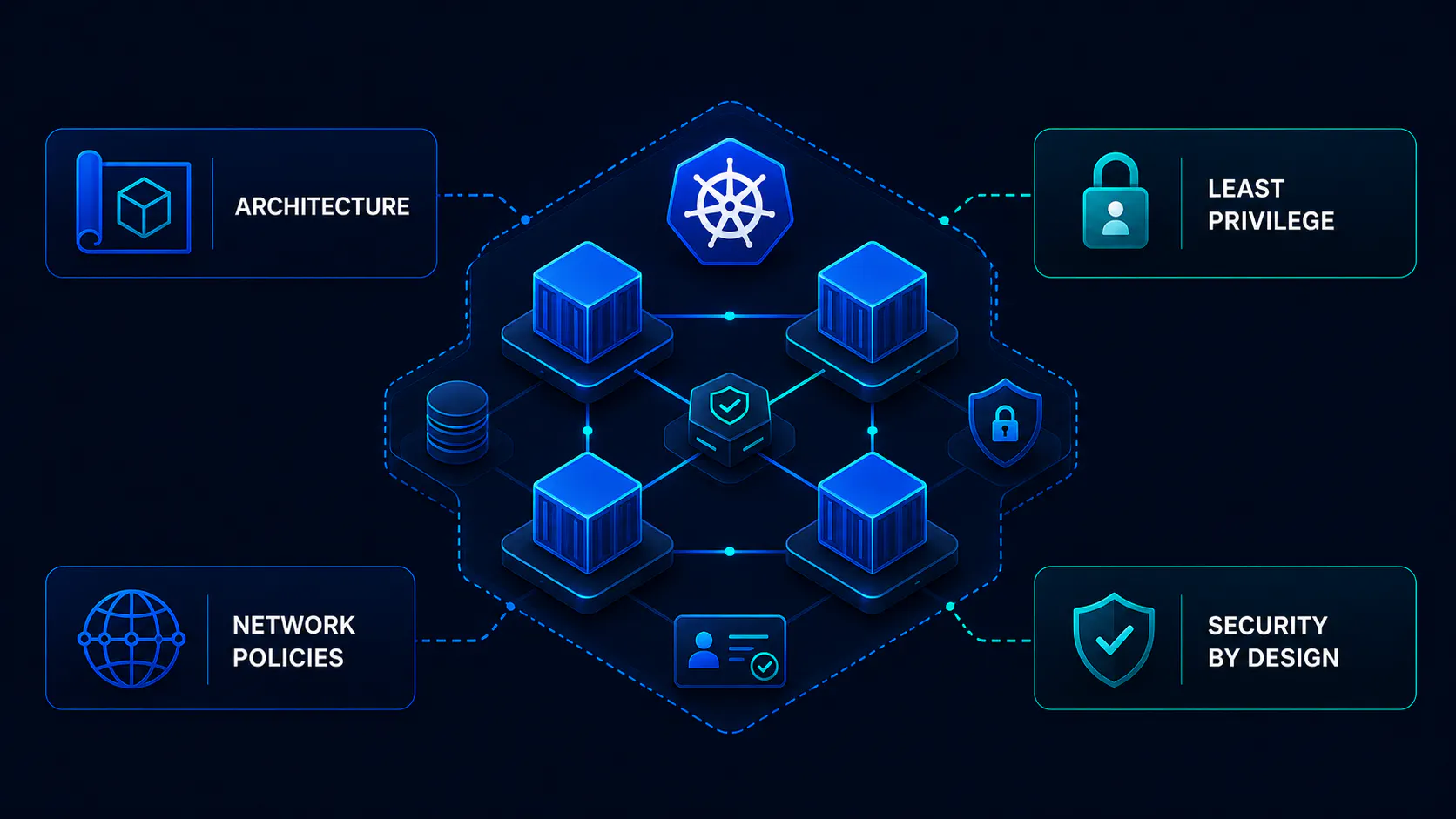
Kubernetes security architecture infographic

Look back at the attack chain and ask which controls would have ended it earliest. Not the detection tools - the architectural ones. Those aren't security products. They're design decisions, made months before deployment.

Most teams get this backwards. They ship a tightly coupled system where every service shares a common credential, then try to bolt segmentation on afterwards - and find that enforcing Network Policies would break production, because nobody knows which service needs to reach which.

That's the expensive version: retrofitting boundaries into a running system, with downtime risk attached to every change. The cheap version is drawing them before the first deploy, when they cost nothing but thought.

Teams that engage microservices consulting early find the architectural work pays for itself twice - once in maintainability, once in the controls that become trivial to apply.

You cannot retrofit a small attack surface. You can only design one.

Conclusion

IDS and IPS remain a necessary part of Kubernetes security in 2026. They stop opportunistic attacks at the perimeter, buy time on unpatched CVEs, and catch traffic leaving the cluster.

They are also, structurally, blind to the middle of every serious intrusion - the identity theft, the API abuse, the lateral movement that happens entirely inside your trust boundary.

The clusters that hold up aren't the ones with the most tools. They're the ones where network detection, runtime monitoring, access policy, and a sensibly segmented architecture each cover what the others can't.

So the question isn't whether you should deploy IDS and IPS. The real question is what happens after they stop seeing the attack.

Read Other articles

How to Adopt Kubernetes: 9 Tips to Simplify Kubernetes Adoption thumbnail

Kubernetes

Yevhenii Hordashnyk

Yevhenii Hordashnyk

CTO, co-founder

advanced


Dec 13, 2022

How to Adopt Kubernetes: 9 Tips to Simplify Kubernetes Adoption

Learn which companies benefit the most from implementing Kubernetes and discover how to simplify Kubernetes adoption with efficient tools and practices.

Kubernetes on Bare Metal: Benefits & Evolution of Management Tools thumbnail

Kubernetes

Bare Metal

Ruslan Timofieiev

Ruslan Timofieiev

DevOps Team Lead

intermediate


Sep 05, 2022

Kubernetes on Bare Metal: Benefits & Evolution of Management Tools

Why are companies running Kubernetes on bare metal? How do you automate provisioning, load balancing, and networking on physical infrastructure? Let’s find out.

Yevhenii Hordashnyk
Let's arrange a free consultation

Just fill the form below and we will contaсt you via email to arrange a free call to discuss your project and estimates.